

Lean Six Sigma Consulting or Training: Which Do You Need?


Both training and consulting can help a business. They just fix different things. Lean Six Sigma training is mostly about building skills. It teaches people how to look at a process, spot waste, work out what's going wrong, and use a proper method to fix it.
Lean Six Sigma Consulting starts somewhere else. It starts with a real problem your business already has. Instead of teaching a method first, a consultant looks at what's actually happening, works out the cause, and applies the right fix to your situation.
That difference matters more than people think. You can have a fully trained team and still have a process that's slow, inconsistent, or full of rework. You can also have a process crying out for help, with nobody in the building who's actually led that kind of fix before.
So the first question isn't "do we need training or consulting?" It's: What are we actually trying to fix? Once you know that, the rest gets a lot easier to work out.
Lean Six Sigma consulting vs training: what's the difference?
Here's the simple version. Training builds skills. Consulting applies those skills to a real problem.
Training usually covers the basics: Lean Six Sigma principles, the tools, the method. Depending on the course, that might mean Yellow Belt, Green Belt or Black Belt. The point is to give people what they need to join in, or even lead, an improvement project.
Consulting kicks off differently. There's already a problem sitting on the table.
Maybe the process is taking too long. Maybe errors keep creeping up. Maybe customers are getting a patchy experience. Maybe a team's buried in rework, or costs are higher than they should be. Or maybe three different departments touch the same process, and nobody's managed to fix it properly. In that situation, the work starts with understanding the problem and the process behind it.
A consultant might dig into the data, map how things actually run, talk to the people doing the work, find where things get stuck, work out what's really causing it, and then help build and roll out the fix. The exact approach depends entirely on the problem.
That's actually one of the important things about good Lean Six Sigma work: the method should fit the problem, not the other way around.
A quick example
Say a business takes 10 days to process a customer request, when customers expect two or three. Training teaches the team how to use process mapping, root cause analysis, and the other usual tools.
Consulting takes those same tools and points them directly at that customer-request process. A consultant might find out the delay has nothing to do with one slow person or one slow team. Maybe information gets typed in twice. Maybe approvals bounce between teams that don't need to be involved. Maybe requests just sit in a queue for days, waiting.
Training teaches people how to investigate a problem. Consulting actually investigates and fixes that specific problem. That's the real difference, in practice.
When does a business need Lean Six Sigma training?
Training makes sense when what you really want is to grow your people.
You're probably after training if:
Your staff need to get their heads around Lean Six Sigma basics
You want improvement skills to live inside the business, not outside it
You're planning to run improvement projects regularly
You want people to have proper Yellow, Green or Black Belt knowledge
You'd rather keep this know-how in-house instead of calling someone in every time
You're building a longer-term improvement habit, not fixing one thing
Training is also handy for getting everyone speaking the same language. Managers, process owners and the improvement team can all end up using the same words for things like waste, variation, root cause and what customers actually need.
6 Sigma Consulting runs Yellow Belt, Green Belt and Black Belt training, along with Agile and Scrum training. But here's the catch worth remembering.
Training on its own doesn't fix a process. Knowing how a tool works is one thing. Using it well on a messy, real process, with real people, real systems, real customers and years of "this is just how we do it", is a different skill entirely.
That's where consulting earns its keep.
When does a business need Lean Six Sigma consulting?
Consulting tends to fit better when you already have a specific problem that needs digging into.
For example:
A process that keeps causing delays
Rework or errors hurting output or quality
Performance that swings wildly between teams or locations
A problem that keeps coming back, no matter what you try
Several departments tangled up in the same process
You genuinely don't know where the waste is coming from
You want to run an improvement project, but nobody internal has done one before
You know results need to improve, but you're not sure where the problem starts
The starting point here is always your real situation, not a textbook one.
A good consultant doesn't rock up with a favourite tool and force your business to fit around it. The first job is understanding what's actually happening.
That might mean looking at how the process performs, talking to the people inside it, checking whatever data exists, mapping how work actually moves, and finding exactly where the delays, waste or variation show up. Only once that's clear can you work out the right fix.
This kind of problem is common right now. The Australian Industry Group's 2026 Industry Outlook found process improvement ranked among business leaders' top priorities for 2026, alongside business development.
Why this matters
A business might think it has a productivity problem, when really the process itself is just badly designed.
It might think staff need more training, when the real issue is nobody actually owns the handover.
It might think one team needs to move faster, when the biggest delay is sitting between two teams, not inside either one.
Skip the step of actually understanding the process, and it's easy to treat the symptom instead of the cause.
That's exactly why Lean Six Sigma Consulting focuses on the business problem itself, rather than just handing over a toolkit.
Lean Six Sigma consulting or training: which one fits your business?
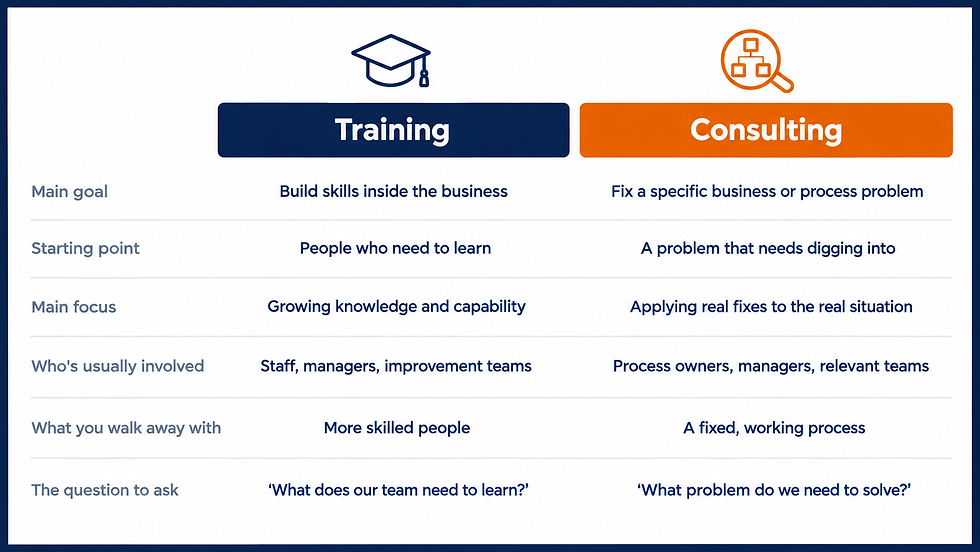
This isn't a forever decision, either. A business can build skills through training while also bringing in a consultant for a tricky, high-priority problem at the same time.
If you've already decided consulting is the right path and want more detail on picking the right person for the job, see our guide on how to choose a process improvement consultant in Australia.
Can a business need both consulting and training?
Yes. And it happens more than you'd think. Sometimes it makes total sense to use both. A business might have a process problem that needs sorting out now, but also wants its people trained up to handle future improvement work themselves.
So consulting tackles today's problem, while training builds up the team for tomorrow. Another way it plays out: bring in consulting first to get the improvement project moving, then train a few people afterwards so they can run similar projects on their own next time.
There's genuinely no rule that says consulting always comes first, or training always comes first. What matters is looking at what the business actually needs. Don't pick training just because the business wants to say it's "doing Lean Six Sigma". Don't pick consulting just because a problem sounds complicated. Start with the actual requirement.
How do you know if it's a skills problem or a process problem?
This is one of the more useful questions you can ask yourself before choosing.

What does a Lean Six Sigma consultant actually do?
It changes a bit from project to project, but good consulting always ties back to a real business need.
A Lean Six Sigma consultant might help you:

How 6 Sigma Consulting can help
6 Sigma Consulting works on real business problems, not classroom exercises. Depending on what's needed, that covers process analysis, value stream mapping, business transformation, the NWOW (New Ways of Working) approach, OKRs, and structured process improvement.
If you're looking for a lean six sigma consultant, go past the certifications and ask the practical stuff: have they actually worked on real business processes, how will they get to grips with your current problem, how will they find the improvement opportunities, how will they measure the result, who from your team needs to be involved, what happens after the recommendations land, and how do you keep the improvement going afterwards.
These questions pull the conversation away from buying a method, and towards actually solving your problem. 6 Sigma Consulting's wider lean consulting services can also help when the problem is bigger than one single process.
What is lean transformation consulting?
Lean transformation consulting means applying Lean principles across a bigger slice of the business, not just fixing one isolated process. The scope can vary a lot.
Depending on the goals, it might touch processes, ways of working, performance management, team structures, how customers experience the business, workflow, and ongoing improvement habits.
That's a different scale to a small process project. Fixing one customer onboarding process, for example, is a focused Lean Six Sigma job. Looking at how several teams, processes and ways of working all feed into the overall customer journey is a transformation-level job.
The right scope just depends on what you're actually trying to change.
What should you look for before choosing a consultant or a training provider?
Before you commit to either, step back and get clear on what you actually need.
1. Start with the problem
Be specific. Is it about cycle time, quality, cost, waste, customer experience, productivity, variation, or something else entirely?
2. Look at the evidence, not the assumptions
Use actual process information wherever you can. Data shows you how big the problem really is, and gives you something to measure against later.
3. Be honest about your internal skill
Got people who can lead an improvement project already? If not, training might help build that. If you've got the people but need extra hands on a tricky project, consulting fits better.
4. Work out how you'll measure success
A proper improvement project needs a clear way to say whether it worked. What that measure looks like depends entirely on the problem.
5. Think about what happens after
Improvements need someone to own them. Work out who'll keep the new process running, who's watching performance, and who steps in if things start slipping back.
What should you do next?
You don't need to know the exact Lean Six Sigma method before you ask for help.
If you've got a process that's underperforming, a problem that just won't go away, or you're genuinely unsure whether you need training, consulting, or both, the first move is simple. Just explain what's going on.
6 Sigma Consulting runs a Business Discovery process, which is a good starting point for talking through your situation and working out what kind of support actually fits.
The useful question here isn't: "Which Lean Six Sigma service should I buy?"
It's: "What problem are we actually trying to fix, and what's stopping us from fixing it?"
Once that's clear, it's a lot easier to see whether the next step is training, consulting, internal work, or a mix of all three.
Businesses can outline their current situation through 6 Sigma Consulting's Business Discovery form, a brief submission that helps identify the most appropriate type of support. Completing the form carries no obligation.
What's the difference between Lean Six Sigma consulting and training?
Training builds your people's knowledge and skill in Lean Six Sigma. Consulting applies that method to a real, specific problem already sitting in your business.
When should a business consider Lean Six Sigma consulting?
When there's a clear process or performance issue that needs digging into, especially if you need extra experience or a fresh, outside look at the process.
Is Lean Six Sigma training enough to improve a business process?
Training gives people the tools and the know-how. It doesn't guarantee the process improves on its own though. Someone still has to actually apply what they've learned to the real problem.
Can a business use Lean Six Sigma training and consulting together?
Yes. Training builds skill inside the team, consulting helps with a specific project. How you combine or order them depends on what your business needs right now.
What does a Lean Six Sigma consultant do?
A consultant helps you understand a process problem, work out what's really causing it, find ways to fix it, help put the fix into place, and check whether it actually worked. The exact scope changes depending on the project.


Comments